

Self-Strength for Reducing Power Imbalance
Only through self-reliance and strength can Cambodia protect itself from its invaders.

Inequality is everywhere — between countries and within countries themselves. It is the imbalance between the power and economic capacity of major and smaller states that has been a long-standing and normalized feature of the global order for more than a millennium. There is no equal position among states, and the only way to reduce this imbalance is through self-preservation and self-strengthening. More Cambodians have now become aware of this reality as the country finds itself calling for help from the international community while facing renewed conflict with Thailand.
From December 7 until today, there have already been 18 days of war between the two nations. The war has forced about 1,000,000 civilians in Cambodia to flee their homes. Many soldiers and civilians have been killed, and many others have been injured. Cambodia has called for an immediate ceasefire, but the prospect of peace remains distant, despite efforts by the international community, including the United States, China, and ASEAN. The war continues, and people in both countries continue to die.
While saddened by the situation, many Cambodians have lost hope in support from multilateral organizations and superpowers. “There are no more international laws. There are only the laws of the jungle: the strong beat the weak,” said Serey Chea, Governor of the National Bank of Cambodia. She continued: “[N]ations are no longer united. Each on their own. So children, educate yourself! Not to beat but to build a better world.’’ She called for self-reliance as a means of national protection.

Indeed, we have witnessed the “law of the jungle” operating globally. For example, the genocide in Gaza and the invasion of Ukraine continue to this day. Multilateral organizations and major states have spent millions of dollars on high-profile meetings, but the problem persists nonetheless. Many people continue to die; children lose parents, suffer from malnutrition, and lack access to education.
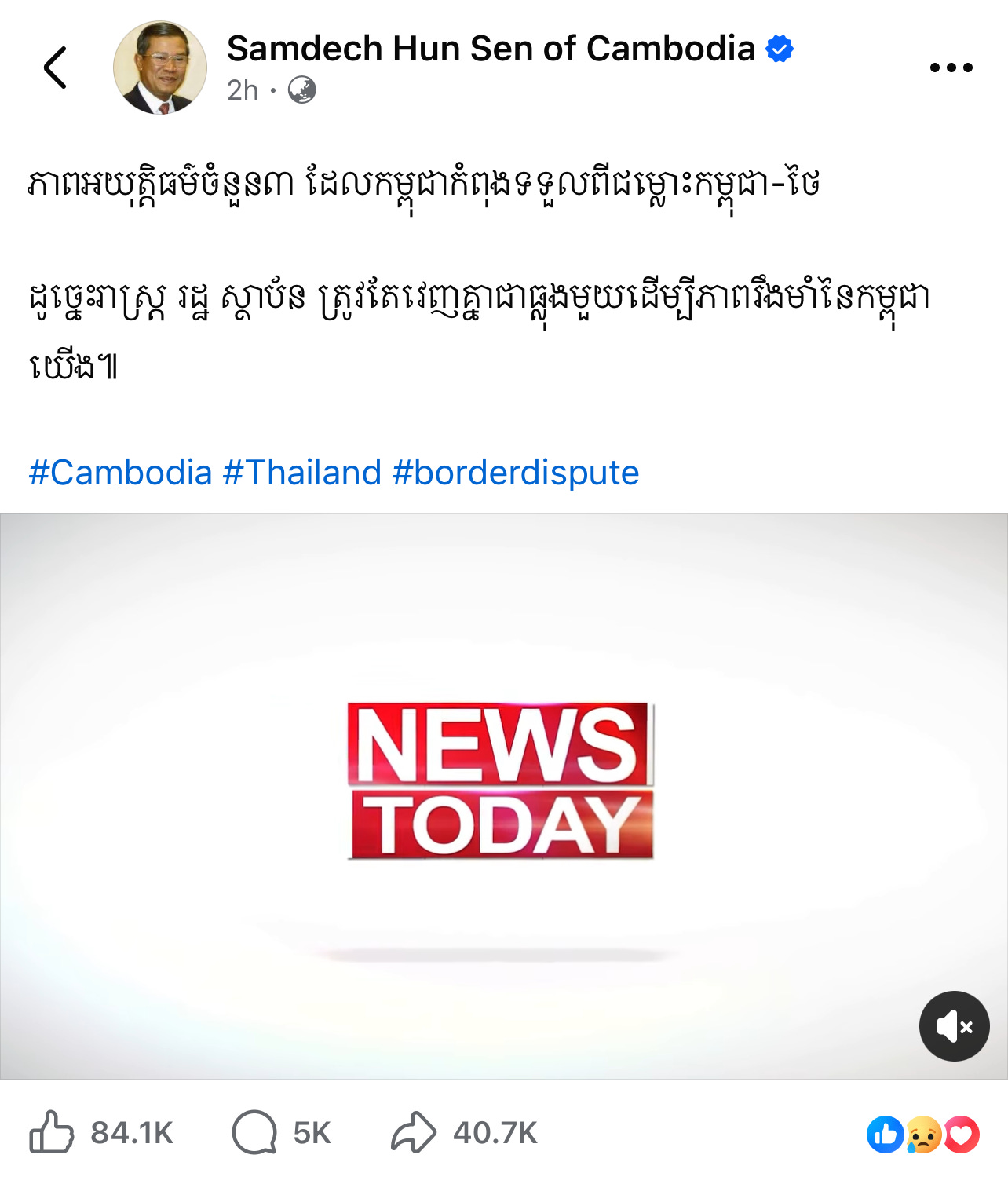
Although Cambodians have lost hope, Cambodia’s political leaders, as I observe, probably never expected the international community to resolve the border conflict with Thailand. Former Prime Minister Hun Sen, now President of the Senate, shared an inspiring post on social media about Cambodia needing to become strong. The post, published by the local news outlet News Today TV, was entitled “Three Layers of Injustice.” Its narrative states:
Cambodia is not only under attack on its own territory. Its honor and dignity are also being wounded by the brutal actions of the Thai military and the Thai government.
We are invaded, yet they claim they are acting in self-defense against threats from us.
We are invaded, yet they claim that this is a campaign to crack down on online scams.
We are invaded, yet we are pressured to declare a unilateral ceasefire.
[…] A small country is forced to accept deception to soothe a larger power. Justice does not arise automatically for the weak. Speaking the truth alone is not enough. Evidence alone is not enough. Power decides who is right. Power decides whose story is accepted as truth. Power decides whose pain and whose deaths are considered worthy. When Cambodia defends itself, others accuse it of provoking conflict. When Cambodia shows restraint, others dismiss it as weak. When Cambodia asks for justice, it is told to be patient.
[…] The path forward for Cambodia is to strengthen the nation in every dimension. We must invest more forcefully in our own capacity. Sharpening our diplomatic tools to expose false narratives, building an economy that is resilient and strong, reinforcing social justice, and confronting corruption. We must turn pain into power by boosting domestic production, streamlining skilled labor, advancing technological and military capability, and building strategic reserves. […] We must bind together as one.
Becoming strong is difficult and requires sustained effort. Cambodia needs “a serious reform,” as Ou Virak, President of Future Forum, a public policy think-tank based in Cambodia, wrote many years ago on Facebook. He argued that if Cambodia aims to become a middle-income country by 2030 and a high-income country by 2050, major reforms in public institutions and policies must begin immediately. It must also use the rule of law as a mechanism for monitoring policy implementation and outcomes.
Many priority areas must be promoted given a tight national budget. Therefore, Cambodia requires smart policies with clear objectives and implications. Importantly, the effective use of financial and human resources will promote economic growth, long-term resilience, social welfare, and national security.
Cambodia must learn from both the successes and failures of advanced economies during their periods of development – when they were poor, as Virak often said. Understanding what they did in the past and what they do today can help Cambodia build a stronger society.
Change takes time and patience, as well as perseverance in the right direction. Over the next 20 years, durable outcomes can emerge from the collective commitment and hard work of all Cambodians.
Cambodia can reduce the power and economic imbalance with Thailand only when it becomes as strong as Thailand, at which point Thailand will no longer have an incentive to use Cambodia as a tool for domestic political gain.